10 mins
Would you trust an AI model's ability to give you investment related or any financial advice of sorts? And the answers remain as usual - split between, "of course! AI is just a mediator - I'll trust it x% and use my brain for the rest." and "no. never". But my predicament is far removed from what users think of AI and finance in the same sentence. As a UX designer, I was tasked with the creation of a financial goal setting tool that collected five user data points about their investment goals, and calculated those to convey the feasibility of their investment. Follow along my process to learn how this became a story in AI interaction patterns and designing communication for user trust.
Data Privacy and financial literacy
Explainable AI Recommendations
MISSION
DAU
Conversion rates → No. of applications filed, pdf downloads
BUSINESS NEEDS
Personalization of data
gamification
UX VALUES

Bridging Business requirements and User Needs - Black Box Friction
The project commenced with a technical audit of the Business Requirements Document (BRD) to identify the specific data inputs required to drive the predictive model. Simultaneously, I conducted qualitative research with young adults to map their mental models of financial algorithms. The core B2C insight was a profound 'Black Box' friction: users expressed low trust in digital tools because the transition from their personal goals to an algorithmic 'recommendation' felt arbitrary and opaque. This established my primary design mandate: to bridge the gap between 30 years of legacy financial data and user skepticism.
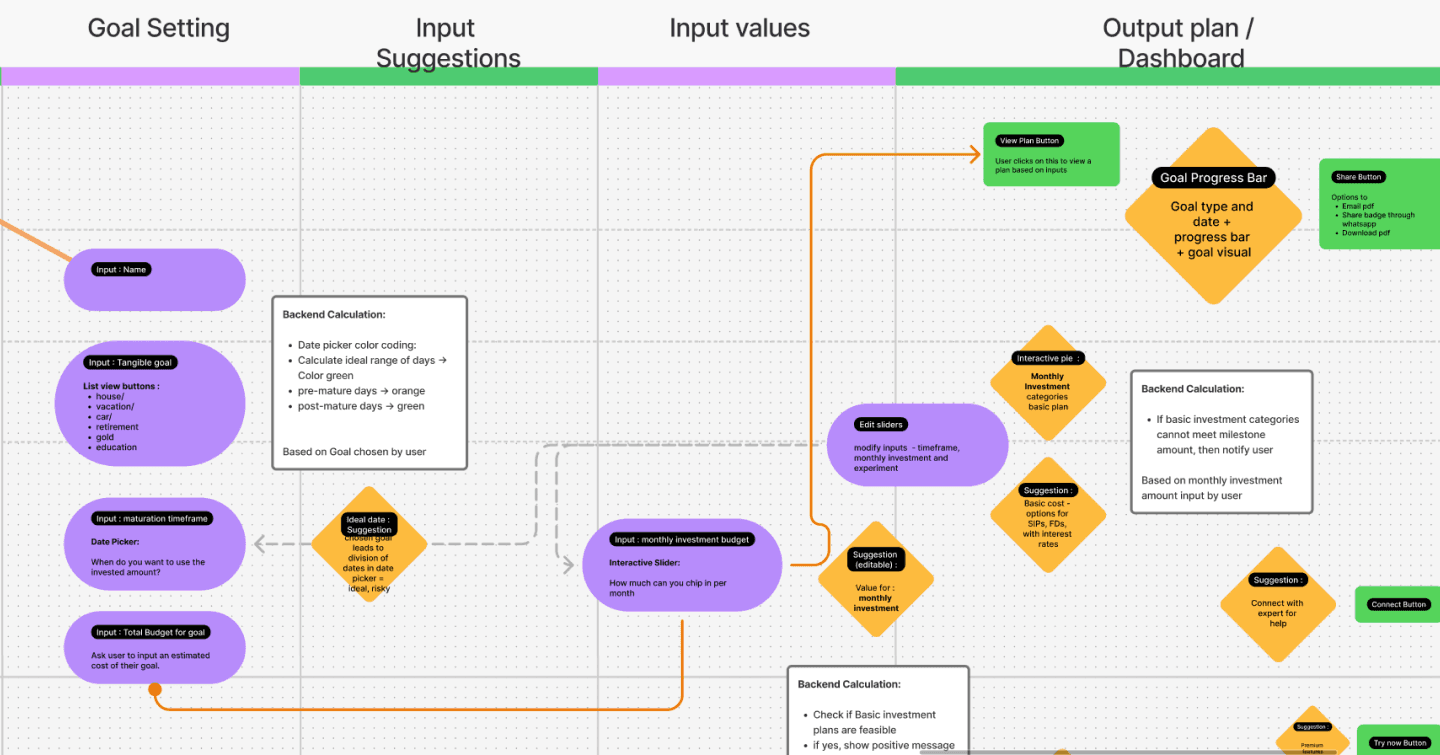
By mapping the intersections of business logic and user trust-thresholds, I developed a Predictive Information Architecture. This was not a standard site map, but a conditional logic map that governed how and when the system’s internal confidence would be surfaced to the user to ensure calibrated trust from the first interaction."
An investment goal tracking dashboard - Progressive Disclosure for AI recommendations
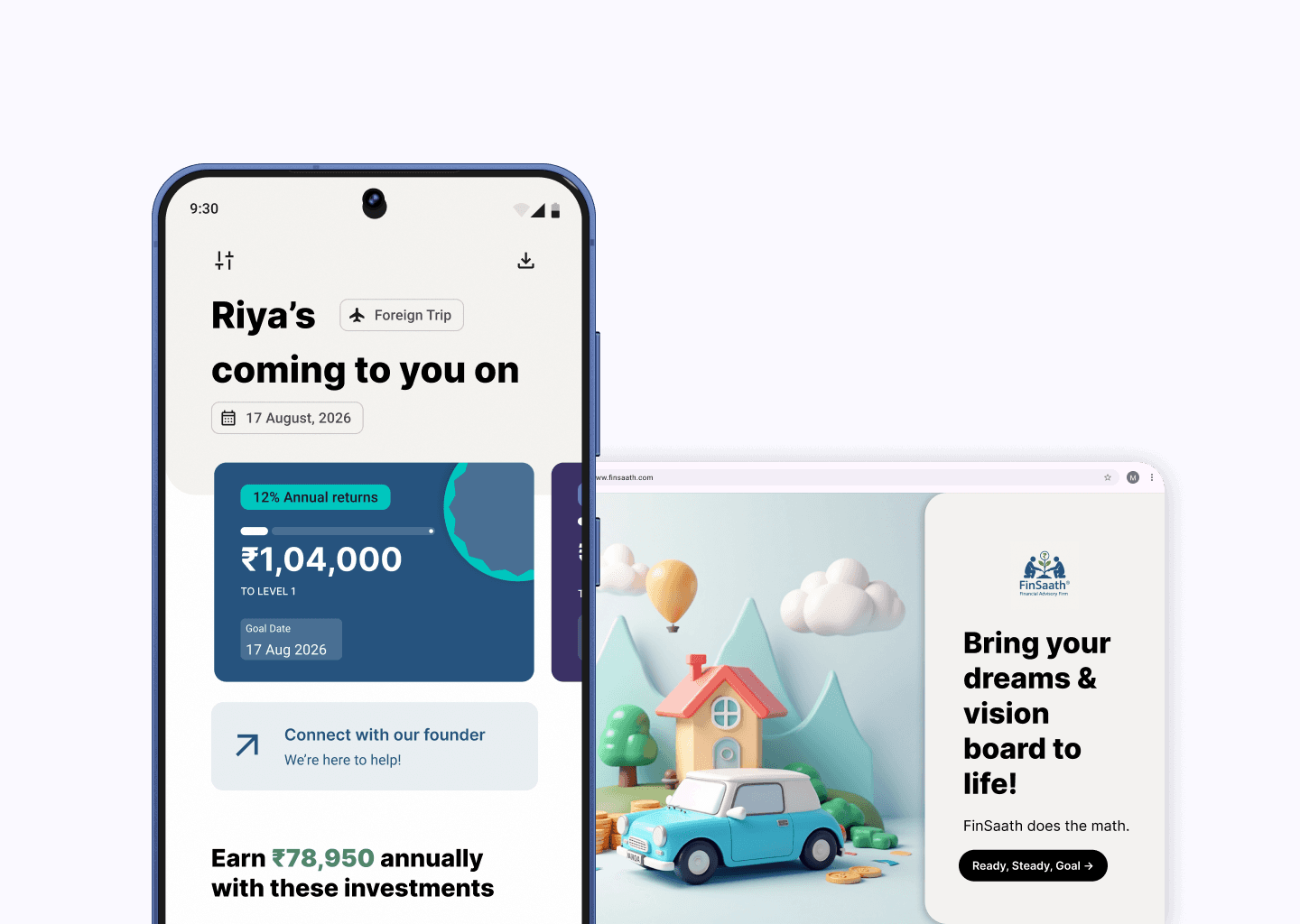
Take a glimpse into what the final output looks like and what if offers. Information was categorized into 5 modules on the dashboard that form a cohesive narrative. Starting with a header summarizing the user's selection - these are editable fields. Followed by progress tracking cards. The call to action button is placed right after to give the user enough information about their investment choices to connect with the business. This is followed by personalized investment suggestion cards and a monthly investment visualizer graph.
Addressing trust-latency gaps in AI goal setting experiences.
This five-step wizard functions as the primary interaction archetype where I translated three decades of historical financial data into a transparent input flow. The core architectural challenge was to bridge the Trust-Latency Gap between the robust financial backend and the user’s need for predictability. By utilizing the Google PAIR 'Explainability' framework, I moved beyond simple layman language to provide the user with a functional mental model of the system’s underlying logic.


Retaining user agency in AI interactions.
By visually constraining inputs based on backend financial logic, I moved the interaction from a standard 'Input-Output' model to a 'Collaborative Dialogue.' This aligns with PAIR’s guidelines on Feedback & Control, where the system adapts its UI to reflect its internal confidence intervals. The model's highest confidence interval—the mathematically optimal intersection of selected timeline and goal—is surfaced as the default center anchor of the slider. The threshold is visual: as the user drags the slider to the left, they cross the model's confidence threshold into a mathematically risky zone. Instead of withholding advice when confidence is low, the UI immediately flags the feasibility risk.
Owning the error recovery path
Interestingly, we had to add a feature last minute into our project, since our previous design only featured warning signals for non-feasible investment inputs pretty later into the experience. Through an informal testing session it was found that 3 of 4 users would not redo the selection process again. To this end, a review your selection page was added to the onboarding segment. This was technically easy to add since we were using modern day routing state frameworks.
Future Scope and Reflection
If I had more time… I would most certainly convince you that an AI assistive tool that can help you with your investment planning can certainly be designed to prove worthy of help - for first time investors (including me). AI models based on accurate historical data such as FinSaath can create an interesting scenario where new users might want to know more than just "try this suggestion" anchors or fool around with slider values. Confidence intervals can be communicated in more meaningful ways where it doesn't have to sound sales-y, "500 users also tried…" or "Increase monthly investment by x" buttons.
Users want to be informed with real time trends and associated tradeoffs. Interaction patterns that don't necessarily surface as prescriptive and "pick me" are a win, in my view. If we can rehash pre-AI interaction patterns to communicate crucial bits of information that users need, in this case - credibility of the backend ML model, a new design could feature a single page interface with a real time investment value graph visualizer and adjustable input fields. This version too, is on the right track since it relies on a simple user flow and not a complex, figure-it-yourself AI dashboard or chatbot with token limits.
There is a need for such quality tools in a market full of AI gimmicks, and having a competitive edge design-wise might not be the hardest part of figuring out a product.
Looking for more?